
What Is Dry Needling? A Brampton Physiotherapist's Guide

Dry needling is a physiotherapy technique that uses thin, solid needles inserted into specific areas of muscle, often called trigger points, to address muscle tension and pain. Unlike injections, no medication or substance is introduced into the body. In Ontario, physiotherapists must be authorized and rostered with the College of Physiotherapists of Ontario (CPO) to perform acupuncture, including dry needling. Whether it is appropriate depends on an individual's condition and assessment.
What Is Dry Needling?
Dry needling is a therapeutic technique used by trained and authorized healthcare professionals to target sensitive areas within muscles, commonly known as myofascial trigger points. These points may feel like tight bands or knots and can sometimes contribute to localized discomfort, tenderness, or referred pain.
The term "dry" refers to the fact that the needle does not contain or inject any medication or other substance. Instead, a thin, sterile, solid needle is inserted through the skin into selected muscle tissue.
Dry needling is also commonly referred to as intramuscular stimulation (IMS), although terminology and techniques may vary between practitioners.
In physiotherapy, dry needling is generally considered an additional treatment technique rather than a standalone solution. A physiotherapist may combine it with:
Therapeutic exercises to improve strength and mobility.
Manual therapy to address movement restrictions.
Stretching to improve muscle flexibility.
Education about posture, movement, and activity modification.
The goal is to help address selected muscular symptoms as part of a broader rehabilitation plan.

How Does Dry Needling Work?
Dry needling focuses on areas of muscle that are particularly sensitive or contain what practitioners identify as myofascial trigger points.
When a needle enters a targeted muscle area, it may produce a brief involuntary muscle contraction known as a local twitch response. This response can sometimes occur when the needle stimulates a sensitive part of the muscle.
Researchers are still studying exactly how dry needling works. Several possible explanations have been proposed, including:
Changes in local blood flow: Needle stimulation may influence circulation in the treated area.
Muscle response: Stimulation may affect muscle tension and the sensitivity of a targeted area.
Nervous system signalling: Needle stimulation may influence how the nervous system processes pain signals.
Dry needling does not guarantee pain relief or resolve the underlying cause of a musculoskeletal condition. It is generally considered alongside other evidence-informed physiotherapy approaches.
Dry Needling vs Acupuncture: Key Differences
Dry needling and acupuncture both involve inserting thin needles into the body. However, they differ in their underlying approaches, treatment goals, and professional training.
Dry needling is generally based on Western anatomical and musculoskeletal concepts, while traditional acupuncture is rooted in Traditional Chinese Medicine (TCM). Medical acupuncture may also use a Western medical framework.
Although both techniques use needles, they are not interchangeable. The appropriate approach depends on the person's symptoms, treatment goals, and assessment.
What Conditions May Dry Needling Help?
Dry needling may be considered for certain musculoskeletal complaints involving sensitive muscles or myofascial trigger points. A physiotherapist may assess whether it could be a suitable addition to an individual's rehabilitation plan.
Some examples include:
Neck and shoulder tension: Sensitive muscles around the neck and shoulders may contribute to discomfort and restricted movement.
Lower back and hip pain: Muscle-related tension around the lower back, hips, and gluteal region may contribute to symptoms.
Calf and hamstring tightness: Certain muscle-related complaints involving the lower limbs may be considered for treatment.
Tension-type headaches: Tight or sensitive neck and shoulder muscles may contribute to some headache symptoms.
Restricted range of motion: Muscle discomfort or sensitivity may sometimes affect comfortable movement.
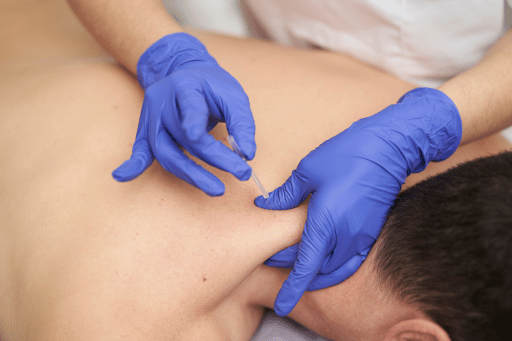
Not all pain originates in muscles. Joint problems, nerve irritation, injuries, and other medical conditions may require different assessment and treatment approaches.
A physiotherapist can help determine whether dry needling is appropriate or whether another treatment option would be more suitable.
What Happens During a Dry Needling Session?
If a physiotherapist recommends dry needling, the session generally involves several steps to support safe and appropriate treatment.
1. Initial Assessment and Medical History
The physiotherapist reviews your symptoms, medical history, previous injuries, and current physical limitations. They may assess muscle sensitivity, joint movement, strength, and flexibility.
This assessment helps identify possible treatment areas and determine whether dry needling is appropriate.
2. Explanation and Informed Consent
Before starting, the physiotherapist explains the procedure, potential benefits, possible side effects, and available alternatives.
You should have an opportunity to ask questions and provide informed consent before treatment begins.
3. Identifying the Targeted Muscle Areas
The physiotherapist identifies the muscles and possible trigger points based on the assessment findings.
The treatment area is prepared using appropriate hygiene and infection-control procedures.
4. Needle Insertion
A thin, sterile, single-use needle is carefully inserted into the selected muscle tissue.
You may experience:
A brief pinching sensation.
A dull ache or temporary discomfort.
A short involuntary muscle twitch.
Mild tenderness around the treated area.
Not everyone experiences the same sensations. The number of needles and treatment duration depend on the individual's needs and the physiotherapist's clinical judgement.
5. Follow-Up Treatment and Aftercare
After needle removal, the physiotherapist may reassess your movement and symptoms.
Depending on your treatment plan, they may recommend gentle exercises, stretching, manual therapy, or temporary activity adjustments.
Following the aftercare instructions provided by your physiotherapist can help you manage any temporary soreness.
Is Dry Needling Safe? Side Effects and Who Should Avoid It
Dry needling is generally associated with minor, temporary side effects when performed by appropriately trained and authorized practitioners using proper safety procedures. However, like any procedure involving needles, it carries potential risks.
Common Side Effects
Some people experience temporary effects following treatment, including:
Muscle soreness: The treated area may feel tender or achy for a short period.
Minor bruising: Small bruises may develop around the needle insertion site.
Temporary bleeding: A small amount of bleeding may occur where the needle enters the skin.
Fatigue: Some individuals report feeling tired after treatment.
Temporary symptom changes: Discomfort may briefly increase before settling.
Research reviews have reported that minor adverse events, particularly soreness and bruising, are relatively common. Serious complications are much less common but can occur.
Rare complications may include infection, nerve injury, or injury to internal structures. Needling around the chest and upper back requires particular care because of the risk of pneumothorax (collapsed lung).
Who Should Discuss Additional Precautions Before Treatment?
Dry needling may not be appropriate for everyone. A physiotherapist should review relevant health information before proceeding.
Be sure to disclose if you have:
A bleeding disorder or take blood-thinning medication.
A weakened immune system or increased infection risk.
An active skin infection, wound, or irritation near the proposed treatment area.
Pregnancy or a possibility of pregnancy.
A history of fainting or significant needle anxiety.
An implanted medical device or other relevant medical equipment.
A condition that may affect sensation, healing, or your ability to report discomfort.
These factors do not automatically mean that dry needling is prohibited, but they may require additional precautions or an alternative treatment approach.
Always discuss your medical history and concerns with the physiotherapist before treatment.
Who Can Perform Dry Needling in Ontario?
In Ontario, dry needling is regulated through the professional authorization requirements for acupuncture.
The College of Physiotherapists of Ontario (CPO) identifies acupuncture, including dry needling, as a controlled act that physiotherapists must be specifically rostered to perform.
This means a physiotherapist must:
Be registered with the College of Physiotherapists of Ontario.
Have the appropriate education, training, and clinical competence.
Be rostered with the CPO for acupuncture, including dry needling.
Follow the College's professional standards and safety requirements.
How Can You Check a Physiotherapist's Authorization?
You can use the CPO's Public Register to verify a physiotherapist's registration and check whether they are rostered for acupuncture, which includes dry needling.
Public Register: https://collegept1.microsoftcrmportals.com/en-US/public-register/
Can a Registered Massage Therapist (RMT) Perform Dry Needling?
In Ontario, Registered Massage Therapists (RMTs) cannot perform dry needling as a massage therapy technique.
The College of Massage Therapists of Ontario (CMTO) permits RMTs to perform acupuncture only when they meet the required education and authorization requirements and practise within the Massage Therapy scope of practice.
Dry needling is a separate technique and is not included within the RMT scope of practice.
Therefore, if you are considering dry needling, you should consult an appropriately authorized healthcare professional rather than assuming that every practitioner who uses needles is qualified to perform this technique.
Dry Needling for Different Types of Pain
Dry needling may be considered for selected muscular complaints. The suitability of treatment depends on the location, cause, and nature of the symptoms.
Dry Needling for Neck and Shoulder Pain
Neck and shoulder discomfort can sometimes involve sensitive muscles around the upper trapezius, neck, and shoulder blade.
Muscle tension may contribute to discomfort, stiffness, and difficulty turning the head or raising the arm.
A physiotherapist may assess whether trigger points are contributing to these symptoms. If appropriate, dry needling may be considered alongside mobility exercises, strengthening, and manual therapy.
Dry Needling for Lower Back and Hip Pain
Lower back and hip discomfort can have several possible causes, including muscular strain, joint-related problems, and nerve irritation.
Muscles around the lower back, hips, and gluteal region may sometimes contribute to pain or movement restrictions.
A physiotherapy assessment can help identify whether muscular symptoms are present and whether dry needling may be appropriate. Other causes of back or hip pain may require different treatment or further medical investigation.
Dry Needling for Muscle Knots
The term "muscle knot" is commonly used to describe a tight or tender area within a muscle.
Some of these sensitive areas may be associated with myofascial trigger points. They can sometimes cause localized discomfort or pain that spreads to nearby areas.
Dry needling may be considered when an assessment suggests that these muscular areas are contributing to symptoms. Other approaches, such as massage therapy, stretching, and therapeutic exercise, may also be considered.
Dry Needling for Sports-Related Muscle Tightness
Athletes and physically active individuals may experience muscle tightness following repetitive movements, demanding training sessions, or sports-related injuries.
When muscle sensitivity contributes to discomfort or movement limitations, a physiotherapist may consider dry needling as one part of a rehabilitation programme.
Treatment may also include progressive strengthening, flexibility exercises, movement retraining, and sport-specific rehabilitation.
The goal is to support a safe return to activity rather than relying on needling alone.
Dry Needling vs Massage Therapy: Which Should You Consider?
Dry needling and massage therapy are different treatment approaches. Both may be considered for certain muscular complaints, but the appropriate choice depends on your symptoms, preferences, and treatment goals.
When Should You Consider Discussing Dry Needling With a Physiotherapist?
A physiotherapy assessment may be worth considering if:
You experience persistent muscle tightness or sensitive trigger points.
Stretching or massage provides only temporary relief.
Muscle discomfort affects your mobility or everyday activities.
You want a structured rehabilitation plan that includes exercises and movement assessment.
You want to understand whether dry needling is an appropriate treatment option for your symptoms.
A physiotherapist can assess your condition and explain whether dry needling or another approach may be more suitable.
When Should You Consider Massage Therapy With an RMT?
Massage therapy may be worth considering if:
You experience general muscle tension or physical discomfort.
You want hands-on soft-tissue treatment.
You are interested in techniques such as deep tissue massage or myofascial release.
You experience stress-related muscle tightness.
You want massage therapy to complement an existing physiotherapy or wellness plan.
An RMT can assess your soft tissues and provide massage therapy within their professional scope of practice.
Can Massage Therapy and Physiotherapy Work Together?
Yes. Massage therapy and physiotherapy may complement each other when treatment is coordinated around your individual needs.
For example, massage therapy may focus on soft-tissue discomfort, while physiotherapy may address strength, movement, flexibility, and functional limitations.
If your symptoms are persistent, severe, worsening, or unexplained, seek an appropriate healthcare assessment rather than relying on massage or dry needling alone.
Is Dry Needling Covered by Insurance in Ontario?
Insurance coverage for dry needling depends on your individual extended health benefits plan and the healthcare professional providing the service.
Many insurance plans include coverage for physiotherapy services. When dry needling is provided as part of an authorized physiotherapy appointment, it may be included within the overall physiotherapy treatment rather than billed as a separate service.
However, coverage is not guaranteed.
Before booking, contact your insurance provider and confirm:
Whether your plan covers physiotherapy.
Whether the physiotherapist must meet specific registration or provider requirements.
Whether dry needling is included as part of an eligible physiotherapy appointment.
Whether you need a physician's referral or prescription.
What annual or per-visit limits apply.
You can also contact the clinic to clarify the service description and billing arrangements before your appointment.
Conclusion
Dry needling is a physiotherapy technique that uses thin, solid needles to target selected muscle areas, including myofascial trigger points. It may be considered for certain muscular complaints, such as neck tension, shoulder discomfort, and sports-related muscle tightness.
Although it shares the use of needles with acupuncture, the two approaches differ in their treatment principles and clinical applications. In Ontario, physiotherapists must be authorized and rostered with the College of Physiotherapists of Ontario to perform acupuncture, including dry needling. RMTs cannot perform dry needling as part of massage therapy practice.
The most appropriate treatment depends on an individual's symptoms, medical history, and clinical assessment.
Looking for physiotherapy or massage therapy in Brampton?
At RMT Movement, we provide massage therapy and other wellness services designed around individual needs. Whether you are experiencing muscle tension, soft-tissue discomfort, or movement-related concerns, our team can help you explore suitable treatment options within each practitioner's professional scope of practice.
Contact RMT Movement in Brampton to learn more about our services or book an appointment.
About the Author
Rui Yao – Registered Traditional Chinese Medicine Practitioner and Acupuncturist
Rui Yao is a Registered Traditional Chinese Medicine Practitioner and Acupuncturist in Ontario. She specializes in acupuncture, moxibustion, herbal medicine, cupping, gua sha, and Tuina massage. Her approach focuses on supporting the body's natural self-healing abilities and promoting overall well-being. Rui has experience addressing various types of pain, mobility concerns, stress, anxiety, sleep difficulties, and digestive concerns through individualized Traditional Chinese Medicine treatments.
Frequently Asked Questions
Does dry needling hurt?
The sensation varies from person to person. Some people experience a brief pinch, dull ache, muscle twitch, or temporary soreness during or after treatment. Others experience minimal discomfort. Your physiotherapist should explain what to expect before beginning and adjust treatment according to your response.
What is the difference between dry needling and acupuncture?
Dry needling generally focuses on muscle trigger points and uses Western anatomical and musculoskeletal concepts. Traditional acupuncture follows principles of Traditional Chinese Medicine, although medical acupuncture also uses Western medical approaches. Both involve needles, but their treatment frameworks and applications differ.
Can an RMT do dry needling in Ontario?
No. Registered Massage Therapists cannot perform dry needling as a massage therapy technique in Ontario. The CMTO permits authorized RMTs to perform acupuncture within the massage therapy scope of practice, but dry needling is a separate technique and is not included in that scope.
What conditions may dry needling help?
Dry needling may be considered for selected muscular complaints involving neck and shoulder tension, lower back and hip discomfort, calf or hamstring tightness, and certain tension-type headaches associated with neck muscles. Suitability depends on an individual assessment.
Is dry needling safe?
Dry needling is generally associated with minor temporary side effects, such as muscle soreness, bruising, and slight bleeding. Serious complications are uncommon but possible. It should be performed by an appropriately trained and authorized professional who follows proper hygiene and safety procedures.
What should I do after a dry needling session?
Follow your physiotherapist's aftercare instructions. You may be advised to maintain gentle movement, stay hydrated, and temporarily adjust strenuous activities if the treated muscles feel sore. Contact your healthcare provider if you experience unusual, severe, or worsening symptoms.
Is dry needling covered by insurance in Ontario?
Some extended health insurance plans may cover dry needling when it is provided as part of an eligible physiotherapy appointment. Coverage varies by insurer and individual policy. Contact your insurance provider to confirm your benefits, provider requirements, and any applicable limits.
Do I need a referral for dry needling in Ontario?
A physician's referral is not generally required to access physiotherapy in Ontario. However, some insurance plans may require a referral or prescription for reimbursement. Check your policy and confirm the requirements with the clinic before booking.


Comments